
Module 2 · Respiratory therapy pathway
Respiratory Care Station
Follow Darius and Leo across respiratory-care settings, a realistic training week, and a fictional hospital shift. Explore how calm science becomes clear support through preparation, explanation, communication, and teamwork.
How this module works
What you will explore
Settings and team
Map how respiratory therapists connect with patients, families, nurses, clinicians, diagnostic teams, and home-care services.
Training and license route
Build a hypothetical student week and separate an accredited program, national RRT credential, and California RCP license.
Fit and next steps
Compare strengths, work realities, practical factors, regional examples, and current official sources before choosing what to investigate next.
Who you will meet
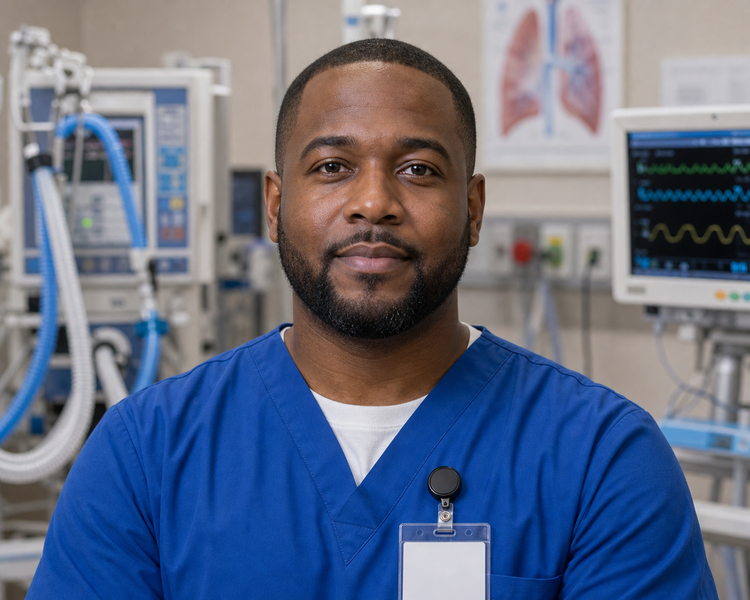
Darius Owens, respiratory therapist
Darius combines science, careful observation, equipment readiness, plain-language explanation, documentation, and teamwork.

Leo Martinez
Leo likes science and equipment. He is learning that the work also needs explanation, supervised practice, feedback, realistic planning, and the confidence to ask when unsure.
Four units in this module
Map the respiratory care team
Connect Darius with work settings, team partners, readiness tasks, and clear questions.
Build Leo's training week
Plan a hypothetical week with class, lab, clinical learning, study, travel, life needs, and support.
Move information clearly
Listen to the podcast, complete Darius's shift activity, and draft an observation-based team update.
Check fit and next steps
Use strengths, demands, practical factors, regional examples, and current sources to choose a next question.
Respiratory care pathway quick guide
Respiratory therapist
Respiratory therapists help care for people who have trouble breathing and work with patients, families, and other members of the care team.
- Settings may include hospitals, diagnostic labs, outpatient programs, sleep centers, and home care.
- Work may include assessment, education, documentation, equipment readiness, and team communication within the professional role.
RRT
Registered Respiratory Therapist, or RRT, is a national credential earned under current National Board for Respiratory Care rules.
- The national exam system changes in 2027.
- Use the current NBRC page instead of an old exam checklist.
- The RRT credential alone does not authorize California practice.
RCP
Respiratory Care Practitioner, or RCP, is the California license title.
- A California RCP license or valid work permit is required before practice.
- Program completion, credentialing, licensure, and employment are separate steps.
- Current board requirements may change.
Program to practice
Use this sequence only as an orientation and verify every step when planning.
- CoARC-accredited respiratory care program and at least an associate degree.
- Current RRT credential required by California.
- Current California ethics-course and application requirements.
- California RCP license or valid work permit.
Activity lineup
Pathway Quick Guide
Read the guide above before comparing the career title, national credential, California license, and broad route.
Respiratory Care Team Map
Build at least four setting connections, add three team roles and four labels, then write one question for a current source or professional.
Build Leo's Week and Route
Make a hypothetical week, mark one pressure point and one support, arrange the broad route, and ask one current program question.
The Quiet Work Behind Every Breath
Use the Keyword Catcher while you listen or read. Record at least four words, one idea, and one question.
Darius's Respiratory Care Shift
Choose what protects accuracy, patient understanding, role boundaries, and teamwork. You will not diagnose or choose treatment.
Breathing-Support Team Huddle
Draft context, exact words or observable facts, one information gap, and the qualified role that needs the update.
Respiratory Care Fit Check
Check strengths, mark practical factors and supports, and choose one clue from the module. Your fit response may stay private.
Official Source Trail and Next-Step Planner
Choose yes, maybe, or not right now. Leave with one action, one current source, and one question.
Podcast transcript
Use this text alternative for The Quiet Work Behind Every Breath.
Read the complete podcast transcript
Welcome to the CareTown Respiratory Care Station.
My name is Darius Owens. I am a fictional CareTown respiratory therapist. The career I help you explore is real, but this story is not a real patient case and it is not medical training.
When people picture respiratory care, they may picture one machine or one urgent hospital moment.
I picture the quiet work around that moment.
At the start of a shift, readiness matters. The team checks approved records, supplies, equipment status, communication tools, and what needs to be clarified. A respiratory therapist does not wait for a difficult moment to discover that something is missing.
Preparation may not look dramatic. It still matters.
Respiratory therapists help care for people who have trouble breathing. Patients can be newborns, children, adults, or older adults. The setting could be a hospital room, an intensive care unit, a pulmonary function lab, a sleep center, an outpatient program, or a home-care service.
The setting changes the day. The need for clear communication does not.
Leo Martinez is a respiratory therapy student in CareTown. Leo likes science and wants to understand how equipment works. At first, he thought the most important skill would be knowing every technical word.
Technical knowledge matters. So does knowing when plain language is better.
Imagine a fictional CareTown hospital shift. An adult patient tells the team, “Breathing feels harder than it did this morning.”
That sentence is information. It is not a diagnosis.
The team needs exact words, observable facts, the current care context, and questions that still need a qualified answer. A student does not choose oxygen, interpret a measurement, change equipment settings, or select treatment. A student listens, follows supervision, and asks when unsure.
I join Elena Ramirez, a registered nurse, and the rest of the licensed care team. Each person has a role. We communicate so important information does not disappear between people.
No one person is the whole system.
The patient asks what I do.
I could answer with a wall of technical language. That would show what I know, but it might not help the patient understand.
Instead, I explain my role in plain language. I check whether the patient has a question. I pay attention to the words the patient uses. Clear explanation is not an extra part of the job. It is part of professional care.
Leo notices that I do not pretend to know something I have not confirmed. If a record is incomplete, I clarify it through the team's approved process. If a concern needs a different team member, I communicate it. If I am uncertain, I ask.
Respiratory care combines confidence with humility.
You need enough confidence to use your education and speak clearly. You need enough humility to verify, follow current standards, and stay inside your role.
After the room feels calm, the work continues.
There may be documentation. There may be a handoff. Equipment may need cleaning, checking, or preparation. Supplies may need attention. The next team needs a clear record of what happened and what still needs follow-up.
Some shifts include urgent moments. Some include repeated patient education. Some include testing, routine checks, setup, travel, or long stretches of careful documentation. Hospital schedules may include nights, weekends, or holidays.
The work can feel meaningful. Helping a person understand what is happening can matter. Supporting a team during a difficult moment can matter. Watching a patient make progress over time can matter.
Meaningful does not mean easy.
The job can include standing, walking, moving equipment, infection-control steps, emotionally difficult situations, and work that requires attention even when you are tired. Different jobs and programs have different technical standards and support options. A disability does not automatically answer the fit question. Current program requirements, job duties, and accommodations need an individual conversation.
Leo's training week is also more than one science class.
There may be anatomy, physiology, respiratory care coursework, skills or simulation lab, supervised clinical learning, study, test preparation, travel, attendance, supplies, meals, and rest. Clinical learning may happen on a different schedule or at a different location than class.
In California, the common career title is respiratory therapist. Registered Respiratory Therapist, or RRT, is a national credential. Respiratory Care Practitioner, or RCP, is the California license title.
A new applicant generally completes a CoARC-accredited respiratory care program and at least an associate degree, earns the current RRT credential required by California, completes current board requirements, and receives a California RCP license or valid work permit before practicing.
The national exam system changes in 2027. That is why a current official source is part of a good career plan.
Crafton Hills College and Victor Valley College are real regional programs students may investigate. They are not CareTown programs or guarantees. Admissions, prerequisites, schedules, costs, clinical requirements, and accreditation status must be checked directly with the college and CoARC.
You do not need to decide today.
Maybe you like science and patient teaching. Maybe you are curious about equipment and teamwork. Maybe the schedule or training plan raises questions. Maybe another pathway fits better.
Yes, maybe, and not right now can all be honest answers.
As you finish your keyword catcher, choose one word that changed how you see respiratory care.
Then write one question you would take to a current program, the California Respiratory Care Board, the NBRC, CoARC, a counselor, or a respiratory therapist.
A good career plan begins with a question you are willing to verify.
Choice 1 of 5
Darius's Respiratory Care Shift
Breathing-Support Team Huddle
Meaningful does not mean easy
What can feel meaningful
Helping a patient understand, supporting a team during a difficult moment, and seeing progress over time can make the work matter.
What may be demanding
Some jobs include nights, weekends, holidays, standing, walking, moving equipment, infection-control steps, urgent moments, and emotionally difficult situations.
What to verify
Program technical standards, job duties, schedules, support options, and reasonable accommodations are specific to the program, employer, and individual. A disability does not automatically answer the fit question.
Real regional examples
Crafton Hills College
A real respiratory care education example in Yucaipa. Verify the current degree, CoARC status, admissions, prerequisites, schedule, costs, and clinical-learning requirements.
Victor Valley College
A real respiratory therapy education example in Victorville. Verify the current application cycle, program format, prerequisites, schedule, costs, and CoARC status.
San Bernardino County RCP
A real employer classification that helps students see the kind of license, credential, teamwork, documentation, and equipment-readiness expectations one employer describes. It is not proof of a current opening or a statewide rule.