
Module 1
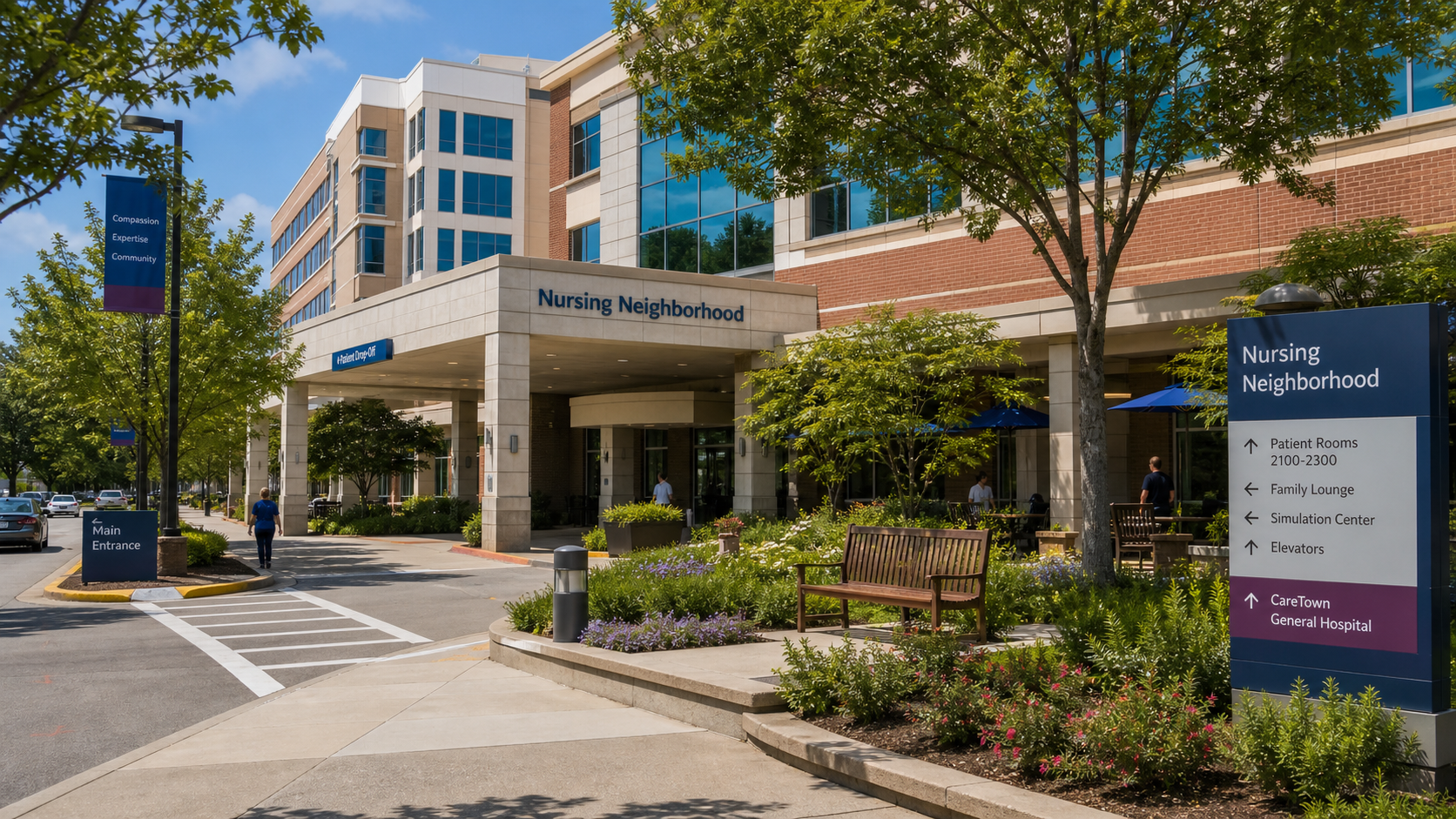
Nursing Neighborhood
Explore how nursing teams care for patients, what different nursing roles may involve, and what questions to ask before choosing a training program.
How this module works
What you will explore
Nursing roles
Compare nursing assistant, LVN, RN, and related real-world patient-care roles without assuming one automatic path.
Training rhythm
Look at how class, skills lab, clinical time, study time, work, and life responsibilities may fit together.
Fit questions
Practice asking about schedule, supervision, patient contact, physical demands, support, and next steps.
Who you will meet

Elena Ramirez, RN
Elena helps patients during busy hospital shifts. She notices changes, communicates with the team, and protects patient trust.

Maya Torres
Maya is learning patient-care skills, study habits, and how to build confidence during training.
Four units in this module
Enter the pathway
Meet Elena and Maya, read the Nursing Routes Quick Guide, and sort common tasks by role, training, license, and setting.
Plan the training week
Use Maya's schedule to compare class, skills lab, study time, clinical preparation, transportation, supplies, and support.
Step into the shift
Play Elena's Busy Shift, then build a focused handoff so the class practices noticing, communicating, and asking for help.
Check fit and next steps
Reflect on strengths, practical realities, and whether Nursing is a yes, maybe, or not right now.
Nursing routes quick guide
Nursing assistant or CNA
A nursing assistant helps patients with basic care needs after training and within the rules of the setting.
- May help with comfort, mobility, hygiene, meals, and vital signs when trained and assigned.
- Reports changes to licensed staff.
- Good question: what training, exam, schedule, and supervision rules apply here?
Licensed vocational nurse
An LVN provides basic nursing care after completing an approved program, passing the required exam, and receiving a license.
- Tasks depend on license, employer policy, setting, and supervision.
- May work in long-term care, clinics, home health, and other settings.
- Good question: how long is the program and what are the clinical, cost, and attendance requirements?
Registered nurse
An RN provides and coordinates patient care after completing an approved nursing program, passing the required exam, and receiving a license.
- May assess, teach, document, coordinate care, and communicate with the team.
- Routes may include associate degree, bachelor's degree, or other approved pre-licensure paths.
- Good question: what prerequisites, program length, clinical schedule, and licensure steps are required?
Patient-care roles to investigate
Some real-world occupations share tasks or settings with nursing roles, but titles can mean different things at different employers.
- Examples: patient care tech, ER tech, telemetry tech, psychiatric aide, orthopedic tech, or health services assistant.
- Ask what training, certification, background check, schedule, and supervision are required now.
Activity lineup
Nursing Routes Quick Guide
Read the short guide above on your own or together so CNA, LVN, RN, and related patient-care roles have enough context before comparison.
Podcast discussion
Use the Podcast Keyword Catcher in your workbook while you listen. Record your own keywords first, then discuss them with a partner, group, or the class if directed.
- Nursing Neighborhood: Skill Meets Trust
Nursing Role Sort
In the workbook, sort task cards into nursing assistant, licensed nurse, many team members, or ask a supervisor. Begin independently, then compare choices with a partner or group if directed.
Maya's Training Week
In the workbook, build a sample week with class, skills lab, clinical time, study, transportation, meals, rest, and support. Build one plan or collaborate on a shared plan.
Elena's Busy Shift
Choose what Elena should do next as the shift changes. Decide independently before discussing, or make each choice with a partner, group, or the class.
Team Handoff Huddle
After Elena's Busy Shift, write one focused handoff: what is happening, what was noticed, and what help is needed. Draft it alone or with a partner or group, then rehearse it aloud if invited.
Nursing Fit Check
In the workbook, check strengths, name practical factors, and decide whether Nursing is a yes, maybe, or not right now. Complete your own fit check before any optional sharing.
Nursing reflection
In the reflection journal, decide whether Nursing is a yes, maybe, or not right now, and save your next best question. Your reflection is individual; sharing is optional unless your instructor gives another direction.
Podcast transcript
Use this text alternative for Nursing Neighborhood: Skill Meets Trust.
Read the complete podcast transcript
My name is Elena Ramirez, and I am a registered nurse in the Nursing Neighborhood.
Today, I want to take you inside one part of nursing. Not the television version. Not the perfect brochure version. The real career-exploration version.
You do not have to decide today whether nursing is your future. That is too much pressure for one module. Your job is simpler and more powerful than that. Your job is to notice what this work asks of people, what it gives back, and what questions you would need answered before choosing a path.
Imagine you are walking into the Nursing Neighborhood with Maya Torres. Maya is a nursing assistant student. She is curious about nursing, but she is also honest with herself. She wants to know what the work feels like, what training might require, and whether this path could fit her real life.
Maya has a notebook open. If you have your Podcast Keyword Catcher, keep it in front of you too. As you listen, write down words that stand out. They might be words like notice, route, support, team, pressure, trust, or maybe. You do not need to write every sentence. Just catch the words that feel important.
The first word I want you to listen for is notice.
When people hear the word nursing, they often picture tasks. Help a patient. Bring supplies. Check information. Give instructions. Take care of someone who is sick.
Some of those tasks may be part of nursing, depending on the role, the training, the license, the setting, and the rules. But nursing is not only a list of tasks.
Nursing is noticing.
It is noticing the patient who says, "I am fine," but does not look fine. It is noticing the family member who asks the same question three times because they are scared, not because they are trying to be difficult. It is noticing when the plan on paper does not match the person in front of you.
When I walk into a room, I am not thinking, "I already know everything."
I am thinking, "What changed? What is this patient telling me? What is the room telling me? Who needs to know?"
That is one reason nursing can feel exciting. You are paying attention in real time. You are close to the human part of healthcare. You may be the person who hears the words first, sees the pattern first, or helps the team understand what is changing.
The second word I want you to listen for is route.
Nursing is not one job. It is a family of roles.
Students may hear about nursing assistants, licensed vocational nurses, registered nurses, and related real-world patient-care roles. These roles can all connect to patient care, but they are not interchangeable. They can have different training, responsibilities, licenses, supervision rules, and work settings.
That is why simple answers can be misleading.
If someone says, "Nurses do this," a better question is, "Which nursing role? In what setting? With what training? Under what rules?"
That question does not make you less serious. It makes you safer and more professional.
Maya noticed that right away. She expected nursing to be one straight road. Then she realized it was more like a neighborhood. Different doors. Different signs. Different routes into patient care.
That can be exciting too. Nursing is not only one type of person, one workplace, one schedule, or one story.
Some nursing work is fast and intense. Some is steady and relationship-based. Some happens in hospitals. Some may happen in clinics, long-term care, home health, schools, community health, or other settings. Details vary, so students should always verify current information with programs, employers, counselors, or official boards.
The bigger idea is this: nursing can include skill and heart. It can include science and communication. It can include routine and surprise. It can include quiet patience and fast teamwork.
The third word is support.
Before Maya ever steps into a clinical setting, she has to look at her week.
At first, she writes down the obvious part: class. Then the week starts filling up.
Skills lab. Study time. Clinical preparation. Transportation. Meals. Forms. Supplies. Family responsibilities. Maybe work. Maybe childcare. Maybe a long bus ride. Maybe the need for a quiet place to study. And somewhere in that week, rest.
Training is not only about being interested. Interest matters, but interest does not drive the bus, read the assignment, pay for supplies, or wake you up after a short night.
A strong student does not pretend the week will be easy. A strong student asks better questions.
What does the real training week look like? What is required? What can change? What support is available? What would I need to plan before I start?
That is not weakness. That is readiness.
Nursing can be rewarding, but rewarding does not mean easy. Training may ask for time, consistency, energy, and support. A student can be interested and still need a plan.
Maya writes one sentence in her notebook: "I need to ask what a real training week looks like."
Not the perfect week. The real week.
The fourth word is team.
No nurse is the whole care team.
That matters.
Nursing can be meaningful because you are close to the patient, but it is also meaningful because you are connected to a team. Depending on the setting, a nurse may communicate with other nurses, providers, nursing assistants, respiratory therapists, pharmacists, case managers, therapists, clerks, families, and many others.
The reward is not, "I did everything alone."
The reward is, "I noticed something that mattered, and I helped the team respond."
Let me give you a moment from a shift.
Mr. Alvarez is dressed to go home. His family has the discharge papers. The wheelchair is waiting outside the room. The plan feels finished.
Then he grips the side rail and says, "My chest feels tight, and I can't catch my breath."
The room changes before anyone has a neat answer.
No one should be guessing. No one should be pretending they know the whole story. But something important has happened.
The plan changed.
This is where nursing judgment matters.
For a registered nurse, a moment like this may mean assessing what changed, staying with the patient as appropriate, calling for help, notifying the right team members, and protecting the patient from moving forward with a plan that no longer fits.
For you as students, the lesson is not clinical decision-making. You are not learning how to diagnose chest tightness. You are not learning treatment steps.
You are learning what nursing work can feel like when noticing, communication, teamwork, and patient safety matter.
A useful team signal is clear. It is not a dramatic speech. It is not a guess.
It sounds more like: here is the situation, here is what I noticed, and here is what help I need.
That is why communication is such a big part of nursing. Clear beats clever.
Now picture the family. A moment ago, they were ready to leave. Now they are scared. A daughter asks, "Is he dying?"
That question lands in the room.
Nursing is not only technical. It is human.
I cannot make promises I do not know are true. I should not dismiss fear. I need to use plain language and keep the team response moving.
I might say, "I hear that you are scared. We are taking this seriously. I am getting help now, and we are going to reassess before he leaves."
What matters here is the shape of the work.
Notice. Stay clear. Call in the team. Protect the patient. Communicate with respect.
Maya does not write, "Nurses are heroes." That sounds nice, but it is too simple.
She writes, "Nurses notice when the plan changes."
That is closer.
The fifth word is reward.
When people talk about rewarding careers, they sometimes make the work sound soft and simple.
Nursing is not soft and simple.
It can be rewarding because it matters.
Reward can look like a patient understanding what happens next. Reward can look like a family feeling less alone. Reward can look like a quiet change being noticed. Reward can look like a team responding because someone communicated clearly. Reward can look like skill growing over time.
That does not erase the hard parts.
Nursing may involve pressure, responsibility, emotional moments, physical demands, long or changing schedules, documentation, and constant communication. Workplaces and roles vary. Training requirements vary. Students should ask current questions before making decisions.
But honest difficulty does not make a career less meaningful.
Sometimes it makes the meaning more real.
The final word is question.
At the end of this module, I do not want every student to say yes to nursing. That would be the wrong goal.
Career exploration is not a sales pitch. It is a way to see more clearly.
If your answer is yes, let it be an informed yes.
If your answer is maybe, let it be a strong maybe.
If your answer is not right now, let it be a thoughtful not right now.
All three answers can be smart.
Yes can mean, "I want to learn more."
Maybe can mean, "I need more information."
Not right now can mean, "I respect what this path asks, and I may choose a different CareTown stop first."
Maya's answer today is maybe. Not because she is careless. Because she is thinking.
She has seen that nursing can be meaningful. She has also seen that it can be demanding. She has seen teamwork, training, rules, pressure, and trust. She has seen that patient care can be personal and technical at the same time.
That is a strong maybe.
Before you leave the Nursing Neighborhood, write three things in your Podcast Keyword Catcher or reflection journal.
First, write one part of nursing that interests you.
Second, write one part that may be challenging.
Third, write one next question you could actually ask.
Your question might be about a program, a role, a schedule, a requirement, a support, or another CareTown pathway.
The question is the win.
My name is Elena Ramirez. I am a registered nurse in the Nursing Neighborhood.
If you remember one thing from this visit, remember this: nursing is where skill meets trust.
Choice 1 of 6